Powered By Blogger

Saturday, 21 September 2013

The Review: South of Elfrida, by Holley Rubinsky


Fellow readers and writers: I have decided to commit half of this blog to voices other than my own (all right, all right, stop cheering). It will be my small effort to shamelessly promote and support other writers. To that end I offer you a monthly book review, which will be followed the week after by an interview with the author.

September brings us South of Elfrida, by Holley Rubinsky.

 South of Elfrida

South of Elfrida is Holley Rubinsky’s newest collection of short stories, eighteen in all. They are distinct, but they also definitely belong together, connecting sometimes through landscape, sometimes through voice or the theme of loss.
I was lucky to hear Holley read from her collection when she came through Penticton last spring. As both a writer and a reader, I find it the ultimate treat to hear another writer read her work out loud and talk about the process by which it was created. Many of the stories in this collection are about characters who are on the road in Arizona in RVs. Turns out Holley took a similar extended road trip and had several adventures along the way, some of which worked their way into these stories. And you can tell: they have that ring of authenticity to them.
One of the things I loved in these stories was the way she makes use of animals to echo how people treat each other (often as predator and prey). In the opening story, a man named Leonard rescuing his niece from an abusive situation is set alongside the rescue of turtle eggs: both are an attempt to keep the vulnerable safe from predators.
The title story is about a group of women birders headed by a rather severe expert known as the hawk man. The narrator, a woman named Jean who is down on her luck, sees a similarity between the hawk man and her military father. “She recognizes the intensity in him, the coldness. She craves his focused energy; she wants in.” In her attempt to impress the hawk man, she suddenly understands that she has been bagged, like one of his birds.
Holley has a wonderful eye for the telling detail. In “Among the Emus,” Crystal “…remembers going to her first AA meeting, dirty bra strap showing.” In “The Compact,” a gem of a story, Sally keeps the ashes from a secret abortion in a powder compact. She rebels against her redneck husband by spitting in the meatloaf she makes him for dinner. In “Coyote Moon,” a rooster is mauled by a bear; a husband suffers from undiagnosed cancer. In the world’s strange arithmetic it is the rooster that survives.  In “At Close Range,” a mother’s secret about her daughter’s paternity finds its way out in a small and surprising way.
Holley tackles some challenging points of view. “Borderline” is told by Paula, a woman with a borderline personality disorder who craves attention but has trouble keeping herself under control if she receives it. “He saw me; he talked to me,” she says near the end, and then must “stand for five minutes until the excitement passes.” Many of the narrators in these stories are lonely and looking for connection wherever they can find it. The stories are rendered with gentleness, honesty and humour.
I will leave you with the final paragraph of “Coyote Moon,” which to me summarizes what so many of these stories are saying. Besides which, I think Holley has the enviable talent of knowing how to end a story well:
“What is the wisdom in loss? What is she supposed to learn? For now, she wants something chased down; she, too, carries grudges. The stars rise like diamonds from behind the mountains into the vivid sky, deep indigo and mauve. This is the first truly dark place Lee has ever lived; nightly she experiences miracles.”

South of Elfrida is published by Brindle and Glass.

Saturday, 14 September 2013

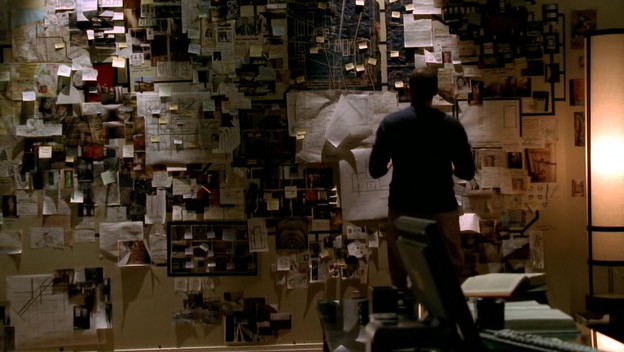
Scofield's Wall


For anyone who doesn’t know, Michael Scofield is the mastermind behind the escape in the t.v. series, Prison Break. The show had its moments (some brilliant dialogue and edge-of-the-seat action) but what captivated me most was Scofield’s wall.

Come on, novelists. Don’t you totally covet that wall? That is the wall of a planner. I want that wall for the novel I’m working on. Sticky notes and photographs and articles and blueprints – Scofield had the escape planned to the second. And like most plans, it didn’t always work out the way he’d expected, and he’d have to go back and try something else (sort of like throwing away fifty pages of work you love because you’ve suddenly realized they serve no purpose other than being loved by you). 

I’ve been coveting this wall for so long that finally, this week, I made my beginning. I’ve put up some cork (since Scofield never had to worry about patching the holes in his wall), added photographs of the way I imagine my characters to look, index cards that plot the novel out chapter by chapter, a list of the books I need to read. My wall has not yet reached Scofield proportions (it’s actually pretty sad by comparison) but it’s coming along.

I’ve noticed a couple of things about outlining so far. One, you have to be willing to be flexible. Sometimes what you thought would work, just…doesn’t. Sometimes in writing the actual story you find a way that’s better than how you’d planned it. Sometimes you get those middle of the night anxiety pangs when you realize one major part of the plot is implausible, or worse – stupid. Down come the index cards. You work it out. New ones go up a few days later.

I’ve learned how hard it is to boil your Big Idea down to a couple of paragraphs – or even worse, one line. I’ve learned that if you can’t do these things, your novel has a problem. It might lack focus or be unnecessarily complex. You might not truly know what it’s about yet or what your protagonist truly wants. Kurt Vonnegut famously advised, “Every character should want something, even if it’s only a glass of water.” An outline forces you to find your character’s glass of water (or whatever it is that you’ve created them to want).

I love this process. Never again would I contemplate writing a novel without making this sort of plan.  Next up: Scofield’s tattoo (just kidding).

Saturday, 7 September 2013

The Inner Critic

Probably most people are familiar with this little voice in their head. If you write, you will know your Inner Critic intimately. Mine is small and thin and has a yellowing little goatee and wears a permanent sneer. He hates everything, tells me that whatever I've just written it won't be good enough and no one will want to read it anyway, and I should just take up knitting or clog dancing instead.

If you ever want to write, it is imperative that you silence this voice, shut him out(or her - maybe your Inner Critic sounds like your piano teacher). I do it over and over - almost every time I sit down to write.

The biggest help to this process for me has been Natalie Goldberg and her book Writing down the bones. Her advice? Don't think too much. Keep the hand moving. Go deep. Find the detail. Follow whatever thread your mind takes you on. Above all, don't be afraid.

Goldberg's method becomes something of a meditation (which is fitting, given her commitment to Zen). Writing for her is a spiritual practice.

Try it now. Pick up a pen, look out your window, and describe what you see - for 5 minutes, without stopping. Just write.